 DIRTY
A language model will happily invent a new alloy before you have finished your coffee. It may even explain, in convincing technical language, why the composition ought to work.
That does not mean anyone should buy the metal.
Before a proposed alloy reaches a furnace or a powder-bed fusion machine, somebody has to answer less glamorous questions. Which phases are likely to form? Could a brittle phase appear? What happens during cooling? Will the material survive heat treatment, welding or the thermal cycling of additive manufacturing?
A new paper in Scientific Reports looks at one way of answering those questions faster. The researchers built a high-performance data engine around CALPHAD, a well-established method in computational materials science, and connected it to process simulation and an AI-assisted alloy-design exercise.
The interesting part is not that AI produced an idea. The interesting part is the machinery used to challenge it.
The useful tool here is CALPHAD
CALPHAD is short for CALculation of PHAse Diagrams. In plain language, it helps engineers predict which phases are likely to exist in a material at a given composition and temperature.
The calculations draw on thermodynamic models and databases built from experimental evidence. They can help estimate when a phase transformation will occur, how much of each phase may be present and how a proposed manufacturing route or heat treatment could change the result.
Think of it as a map rather than a verdict. A good map can rule out bad directions and point towards promising ground. It cannot tell you everything you will find when you get there.
The quality of a CALPHAD result depends on the database, the underlying models and the part of composition space being explored. If the relevant data are weak, a faster calculation only produces an uncertain answer more quickly.
Why these calculations become a bottleneck
One calculation is manageable. A large simulation may need thousands of them.
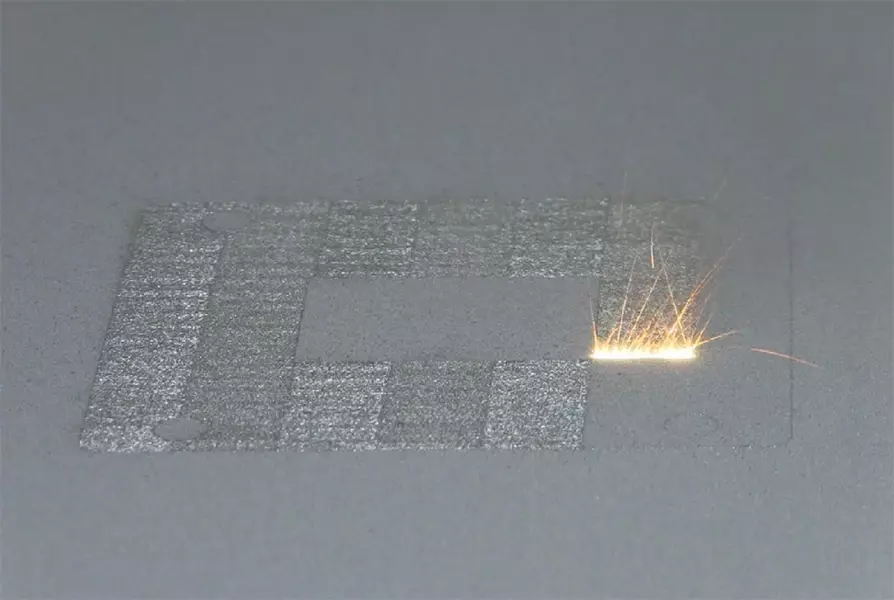
Laser powder-bed fusion shows why. As the laser moves across the powder, different parts of the build heat and cool at different rates. Each new pass affects the material below it. Properties change with temperature, and the local thermal history influences solidification and microstructure.
A useful process model has to keep asking for updated material information. Put that inside an optimisation loop that is comparing many possible compositions, and the workload grows quickly.
The framework in the paper avoids doing the same work repeatedly. It reuses thermodynamic states that have already been evaluated, groups finite-element cells where appropriate and adjusts how often some kinetic and microstructural calculations are updated.
The researchers tested the system with a cobalt-chromium-iron-manganese-nickel alloy family. They report that the first high-throughput run was about 11 times faster than direct point-by-point calculations while producing consistent results. When the system could reuse previously calculated state-space data, repeated queries were accelerated by roughly four orders of magnitude.
That is an impressive benchmark. It is also a specific benchmark. It applies to the system, database, hardware and workflow described in the paper, not to every CALPHAD calculation ever made.
The language model suggests; thermodynamics pushes back
The paper also includes an AI-assisted exercise involving alloys for cryogenic use. A language model proposed compositions and processing conditions. CALPHAD calculations were then used to screen those suggestions.
This is a sensible division of labour.
Language models are good at producing possibilities. They can connect ideas found across technical literature and offer a starting point that a researcher might not have written down unaided. They are also capable of presenting a poor suggestion with complete confidence.
A thermodynamic calculation gives the proposal something solid to collide with.
If the predicted phases do not support the idea, the candidate can be dropped before anyone melts material. If the result looks promising, it earns further work. That is valuable because physical experiments are slower and more expensive than generating another line of text.
The calculation is a filter, not an approval stamp.
Nobody is skipping the laboratory
A composition can look reasonable on a screen and still be a poor material in practice.
Real production brings contamination, melting losses, segregation, porosity, inclusions, grain structure, residual stress and equipment-specific thermal histories. A specimen made in one machine may not behave exactly like a part made in another. A heat treatment that works on a small coupon may become difficult to control in a larger component.
Then the material has to be tested for the job it is meant to do. Strength, ductility, toughness, fatigue, creep, wear, corrosion and weldability are different questions. An improvement in one can come at the expense of another.
For safety-critical work, there is also qualification: repeatable batches, traceable records, recognised test methods and evidence that the process stays under control.
No language model and no thermodynamic database can sign off that chain of evidence. Engineers, technicians and inspectors still have to make the material, examine it, break test pieces and decide whether the result is good enough.
Why a workshop should care
Alloy design can feel remote from the shop floor, but its consequences arrive there eventually.
A new composition may be stronger at low temperatures and harder to weld. A powder may print well inside a narrow process window and crack as soon as the cooling conditions shift. A material may machine cleanly after one heat treatment and ruin tools after another.
Better computational screening should mean fewer blind experiments and a clearer reason for choosing a particular process window. It can help the materials team arrive at the workshop with better questions.
It also makes practical knowledge more important, not less. Somebody still has to notice that the real material is behaving differently from the model. Somebody has to decide whether the discrepancy comes from the database, the process, the test piece or the machine.
The software narrows the search. Experienced people work out what actually happened.
The benchmark deserves context
Most of the paper's authors work for CompuTherm, the company behind the Pandat materials software ecosystem. The other authors are from the University of Wisconsin-Madison. The paper states that it received no external funding and that the authors declared no competing interests.
The commercial connection does not invalidate the result. It does make independent testing with other databases, alloy systems and software worthwhile before treating the reported speedups as universal.
What the study does show is useful enough: thermodynamic data can be delivered much faster in the reported workflows, and a language model becomes more credible when its suggestions are forced through a physics-based check.
That still leaves the most important part of materials development untouched. The alloy has to be made, processed, inspected and tested.
AI can put more ideas on the table. Thermodynamics can clear away many of the bad ones. The furnace and the test lab get the final word.
References and original documents
This is an independent explanation, not a hands-on test or endorsement.
- Scientific Reports — A high performance CALPHAD data engine for scalable ICME and AI-assisted materials design — Primary peer-reviewed paper, published 29 September 2026; benchmarks, additive-manufacturing coupling and AI-assisted alloy-design demonstration.
- DOI record — 10.1038/s41598-026-73329-6 — Permanent identifier for the research article.
- NIST — Additive Manufacturing of Metals — Authoritative background on the relationship between measurements, computational modelling, material development and qualification in metal additive manufacturing.
- NIST — powder-bed fusion image — Source and credit page for the real powder-bed fusion photograph used as the cover image.
- NIST-JARVIS — integrated materials design tools — Authoritative example of integrated computational tools and data used to design and evaluate materials.
Computational predictions and AI-generated alloy suggestions do not qualify a material for production or safety-critical service. Manufacturing trials, metallography, property testing, uncertainty assessment, repeatability and all applicable standards remain necessary.
Comments
Real experience is welcome here. Disagree with the article, the sources or another comment — keep it useful and respectful.
No comments yet. Start the discussion.