 DIRTY
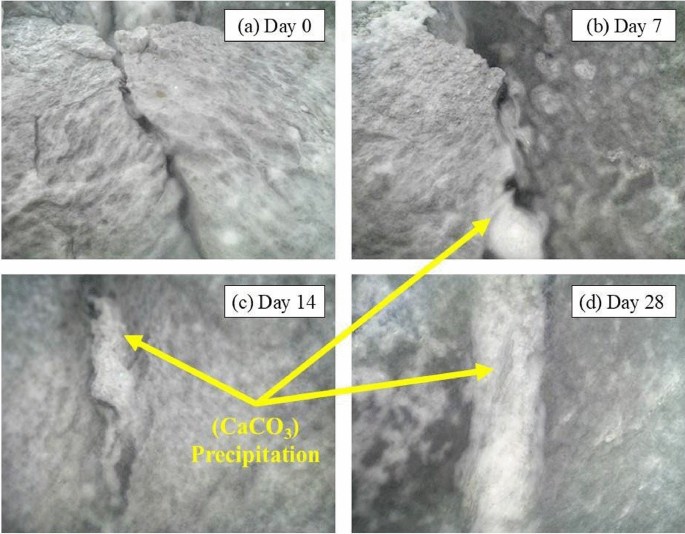
Concrete cracks. That is not a new problem, and it is not automatically proof that somebody mixed the concrete badly.
Shrinkage, temperature change, restraint, loading, settlement and reinforcement corrosion can all produce cracks. The engineering problem starts when those cracks become pathways for water and aggressive substances.
That is where self-healing concrete becomes interesting.
But the name creates a dangerous mental picture. This is not concrete behaving like human skin. A visible crack can close while the original mechanical performance is only partly recovered. A surface can look repaired while transport through the crack is still possible below it.
So before calling anything “healed”, ask a harder question:
What exactly recovered — appearance, watertightness, durability, or structural capacity?
Recent reviews treat crack closure, recovery of transport properties and mechanical recovery as separate outcomes. That distinction matters because they are not interchangeable.
The problem: a crack is more than a line on the surface
On site, the visible crack width is only the beginning.
You still need to know why it formed, whether it is active, whether water is moving through it, what environment the concrete is exposed to, and whether reinforcement is at risk.
That matters because many self-healing technologies are primarily being developed to improve crack sealing and durability-related performance, not to replace structural diagnosis or conventional repair.
A crack can close at the surface and still leave unanswered questions about stiffness, load transfer, corrosion protection and repeat movement.
Concrete already has a limited ability to heal
There are two broad ideas hiding under the same name.
Autogenous healing is the limited natural healing ability of cementitious materials. When moisture reaches a crack, continued hydration of previously unhydrated binder and precipitation of products such as calcium carbonate can help partially seal small cracks.
The effect depends strongly on crack width, age, moisture, cement chemistry and exposure conditions. A 2023 review in Construction and Building Materials identifies crack width and water availability among the important factors controlling healing efficiency.
In plain workshop language: concrete already knows one trick. Researchers are trying to make that trick more reliable and useful.
Autonomous healing: putting the repair system inside the material
Engineered systems add something specifically intended to react after cracking.
Researchers have investigated bacterial systems, capsules containing healing agents, crystalline admixtures, superabsorbent polymers and vascular delivery systems.
The bacterial route gets most of the headlines because the mechanism sounds almost impossible the first time you hear it.
But the interesting part is not that bacteria “rebuild” concrete. They do not.
Their role is much narrower: under suitable conditions, bacterial activity can help drive mineral precipitation inside cracks.
Different systems use different bacteria, nutrients and chemical pathways, so there is no single universal recipe called “bacterial concrete”.
What the bacteria actually do
One of the best-known systems was developed at TU Delft.
The researchers describe a healing agent based on bacterial spores with lactate as a carbon source. Under suitable conditions, the system promotes mineral formation that can help seal cracks.
The important point is that this is a crack-sealing mechanism, not a tiny construction crew rebuilding a damaged beam.
That distinction is not semantics. It tells you what to measure.
If the goal is watertightness, permeability matters.
If the goal is structural recovery, mechanical testing matters.
A photograph of a white mineral bridge across a crack proves neither by itself.
The famous 0.8 mm number — and what it really means
You will often see claims that bacterial concrete can heal cracks up to 0.8 mm wide.
That number has a real source.
Renée Mors and Henk Jonkers reported that, under laboratory conditions, the TU Delft system showed self-healing of cracks up to about 0.8 mm, depending on the dosage of healing agent.
Those three words — under laboratory conditions — must stay attached to the number.
It does not mean every bacterial concrete mix will close every 0.8 mm crack in a bridge, basement or retaining wall.
Healing performance varies with crack geometry, moisture, temperature, pH, time, material composition and the particular healing system.
So this sentence is misleading:
Self-healing concrete repairs 0.8 mm cracks.
This one is defensible:
A TU Delft bacteria-based system demonstrated healing of cracks up to 0.8 mm under specific laboratory conditions.
That is the difference between engineering reporting and marketing.
The dirty-hands test: does it stop the water?
For many structures, this may be more useful than whether the crack looks closed.
Think about a basement wall, tunnel lining, water-retaining structure or other concrete exposed to moisture.
If a healing process reduces water transport through a crack, it may improve the barrier function of the material and help limit the movement of aggressive substances.
That is why researchers use water-permeability testing as one way to quantify healing.
A review in Cement and Concrete Composites describes water permeability as a useful indicator for evaluating self-healing performance and also notes that the measured result is strongly influenced by crack characteristics and morphology.
This exposes one of the easiest mistakes to make when looking at laboratory images:
surface closure is not the same measurement as watertightness.
And neither one is the same as recovery of strength.
What happened when TU Delft went full scale
Laboratory specimens are controlled.
Real construction is not.
Mors and Jonkers reported four full-scale demonstrator projects: two involving repair mortar and two concrete construction demonstrators.
The important result was not a spectacular “before and after” photograph.
The researchers reported that adding the bacteria-based healing agent produced no observed negative side effects on construction performance in those demonstrators.
But they also reported a limitation that is just as important:
the structures hardly cracked.
That made it difficult to prove increased crack-healing performance in the field.
That is good engineering reporting. If a field trial cannot generate the condition needed to test the hypothesis, you do not pretend it proved more than it did.
What the latest research still says
The field has moved well beyond one bacterial system.
A 2026 open-access review in the International Journal of Concrete Structures and Materials covers autogenous healing, microbial approaches, chemical admixtures, nanomaterials and other techniques.
Another 2026 review of self-healing concrete emphasizes how heterogeneous the evidence still is: studies use different crack geometries, cracking methods, exposure conditions, healing durations and performance metrics.
That makes simple headline comparisons dangerous.
A material that performs well under continuous immersion may behave differently on a wall that gets wet only after rain.
A crack that closes in a small laboratory specimen is not automatically equivalent to a moving crack in a real structure.
Practical checklist before believing a self-healing claim
If somebody is selling a self-healing concrete system for a real project, start with six questions.
What crack width was actually tested?
Ask for the tested range, not only the largest number in the brochure.Under what exposure conditions did healing occur?
Continuous immersion, wet/dry cycling and outdoor exposure are different environments.What was measured?
Surface crack closure, water permeability, chloride transport, stiffness or mechanical recovery?How long did healing take?
Seven days, 28 days and several months are not equivalent.Was the evidence laboratory-only, or was there full-scale validation?
What happens if the crack moves again?
A crack driven by an unresolved structural mechanism cannot be treated like a static laboratory crack.
Those questions matter more than the word “bio” on the product sheet.
The biggest trap: closed does not mean restored
Imagine a cracked concrete element.
Twenty-eight days later, the opening has mineral deposits across it.
The camera says success.
The engineer still has work to do.
Did stiffness recover?
Did load-carrying behaviour recover?
Is water transport reduced through the full crack depth?
Is reinforcement protected?
Is the crack still moving?
Can the new material survive another opening cycle?
Those are separate engineering questions.
That is probably the most important lesson in the entire subject:
crack closure, permeability recovery and structural recovery are not the same result.
Water is both the problem and part of the solution
Water entering cracks is one of the reasons concrete durability can deteriorate.
Ironically, moisture is also important to several healing mechanisms.
It supports continued hydration, mineral precipitation and bacterial activity in many experimental systems.
The 2023 review on factors influencing self-healing mechanisms describes water as a key trigger for both autogenous and ureolytic bacteria-based healing.
That means a result achieved under permanent laboratory immersion should not be casually transferred to a dry façade or a crack that only sees occasional rain.
Always read the exposure conditions before the percentage improvement.
So is self-healing concrete real?
Yes.
There are real mechanisms, peer-reviewed laboratory results and full-scale demonstrator projects.
But the practical promise is narrower than the name suggests.
Today, the strongest case is to treat self-healing technologies as durability and crack-sealing tools whose performance must be demonstrated for the actual material, crack and exposure condition.
They are not a universal replacement for inspection, structural assessment or conventional repair.
The interesting part is not that bacteria can “fix buildings”.
They cannot.
The interesting part is that engineers are learning how to put a repair mechanism inside a material before damage occurs.
For the right crack, in the right environment, that mechanism can help form material inside the crack and improve sealing.
That is useful.
But when somebody shows you a photograph of a closed crack and says the concrete healed itself, ask the dirty-hands question:
Did you close the crack — or did you restore the concrete?
Those are not the same thing.
References and original documents
This is an independent explanation, not a hands-on test or endorsement.
- Mors & Jonkers — RILEM Technical Letters / TU Delft — Peer-reviewed full-scale demonstrator paper; TU Delft bacteria-based system; laboratory crack healing up to 0.8 mm under stated conditions.
- TU Delft Research Portal — Bacteria-based self-healing concrete — Institutional record and abstract for the full-scale demonstrator study.
- Mayar et al. — Construction and Building Materials (2023) — Review of factors influencing autogenous and bacteria-based self-healing; crack width, water, pH, temperature and other variables.
- Hou et al. — Cement and Concrete Composites (2022) — Review of water-permeability testing as a quantitative indicator of self-healing performance.
- Ali et al. — International Journal of Concrete Structures and Materials (2026) — Open-access review of mechanisms, performance and current self-healing concrete techniques.
- Self-healing concrete — 2026 critical review — Recent review covering crack closure, permeability/durability recovery, mechanical recovery, field relevance and testing variability.
- Rahman et al. — Bulletin of the National Research Centre (2025) — Open-access CC BY 4.0 laboratory study used for the cover image; Bacillus subtilis-treated cement mortar.
Self-healing concrete does not replace structural assessment, qualified repair design, applicable codes, product approvals or site-specific engineering judgment. A visibly closed crack is not proof that structural capacity has been restored.
Comments
Real experience is welcome here. Disagree with the article, the sources or another comment — keep it useful and respectful.
No comments yet. Start the discussion.